 PPTF
PPTFInstant funding or challenge
Instant funding is access to an account with no evaluation stage: you pay the fee and trade straight away. We work out how an instant funding prop firm differs from a one phase challenge, whether prop firms without a challenge exist and what lies behind the promise of a free prop challenge.
Three ways to get an account
What separates them is not the presence of rules — drawdown limits are everywhere — but when and with what you pay for access.
Two evaluations in a row: a target of around 10%, then around 5%. The fee is the lowest of all, but it usually takes several attempts, and each one takes weeks.
cheaper to enterOne evaluation instead of two. Shorter in time, higher in fee and tighter in terms: FTMO's 1-Step sets the daily limit at 3% instead of 5%, and trailing instead of static.
faster, but tighterNo evaluation at all: the account is issued right after payment. The fee is the highest, there is no profit target, the drawdown limits remain.
dearer, but immediateInstant funding prop firm: where the catch actually is
The absence of stages looks like a concession to the trader, but the firm loses nothing by it: it moves the risk into other terms. Those are what you should check, not the mere fact that there is no evaluation.
Four places where instant takes its cut
- The size of the fee
- Usually several times the price of a challenge for the same account size: the firm collects up front what it would otherwise have collected in resets.
- The tightness of the limits
- There is no profit target, so the limits are the only filter left — which is why they are often tightened, right up to trailing from equity.
- The payout threshold and schedule
- The first payout is often pushed back: a minimum number of trading days or a percentage of profit is required before the first request.
- The split at the start
- Often lower than for those who passed an evaluation, and it grows only under the scaling plan. A gap of 10 pp matters more over a long run than the fee does.
Prop firms without a challenge and the “free prop challenge”
Both expressions describe real offers, but not what they seem to. Prop firms without a challenge are exactly instant funding: there is no stage, but you pay more and earlier. A free prop challenge usually means one of three things, and none of them equals “access at no cost”.
Two models in the numbers of live programmes
The comparison is not abstract: the terms are taken from the same nine programmes covered in the catalogue. You can see exactly what a trader pays for skipping the evaluation stage.
| What is compared | Challenge | Account without evaluation |
|---|---|---|
| Profit target | yes: usually 8–10% per stage | none at all |
| Minimum trading days | from 1 to 5 depending on the scheme | usually not required |
| Daily limit | as a rule 3–5% | both 3% and 6% occur |
| Maximum drawdown | 6–12%, either static or trailing | more often trailing, 6% |
| When the first payout comes | after the stages are passed | 14 days after the first trade or after 5 profitable days |
| Entry price | lower, but multiplied by the number of attempts | higher for the same account size |
The numbers are ranges across nine programmes on the date checked, not an industry standard: each scheme inside a programme has its own values. The one practical conclusion from the table: without an evaluation the profit target disappears, but the drawdown becomes stricter and more often trailing — the risk does not vanish, it moves.
Frequently asked questions
What is instant funding?
Access to a prop account with no evaluation stage: you pay the fee and start trading straight away. There is no profit target, the drawdown limits remain, and the fee is usually several times the price of an ordinary challenge.
Is instant funding cheaper or dearer than a challenge?
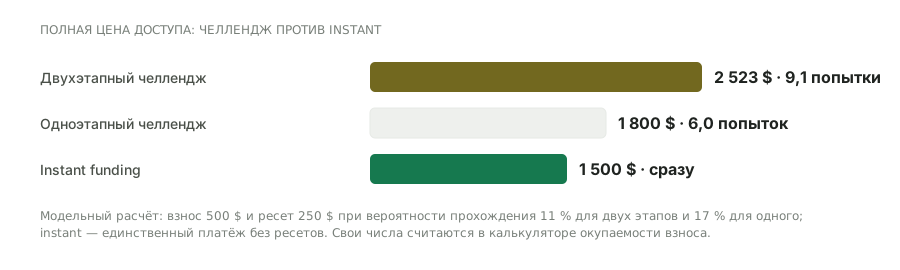
Dearer to enter; on expected outlay it depends on your probability of passing. At a probability of around 10% a challenge with resets works out dearer than instant's single payment; at a high probability the challenge is better value.
How does a one phase challenge differ from a two-step one?
By one evaluation instead of two and by tighter terms. FTMO's 1-Step has a 3% daily limit against 5%, a trailing maximum instead of a static one, plus a Best Day Rule. Shorter in time, stricter in requirements.
Do prop firms without a challenge exist?
Yes, and they are the same instant funding: there is no evaluation stage. But “without a challenge” does not mean “without rules”: the drawdown limits, the bans and the payout terms all remain in full.
Is there such a thing as a free prop challenge?
Three different offers are called free: a contest with an account as the prize, a refund of the fee for an action, and trial access with no right to a payout. None of them gives access to money at no cost — only the form of the cost changes.
What should a beginner with no statistics choose?
Neither: with no trade history there is nothing to compute a probability of passing from, and any choice is a bet. First two hundred trades of your own statistics, then a comparison of the options.
Does instant funding have a profit target?
Usually not — that is its main distinction. But there is often a requirement of minimum profit or a number of trading days before the first payout request, and in terms of time that resembles an evaluation stage.
Is the split the same with instant funding?
Often lower than for those who passed an evaluation, and it grows only under a scaling plan. A gap of 10 pp is worth counting over several cycles: it can outweigh the saving on stages.
Can you move from instant to an ordinary challenge?
They are separate products, not steps: moving means a new purchase. Statistics accumulated on an instant account are usually not taken into account.
Why are the limits tighter with instant funding?
Because there is no profit target and the limits are the only filter left. The firm makes up for the missing evaluation by tightening the drawdown — right up to trailing from equity, where a cushion of profit never builds up.
Read next
