 PPTF
PPTFAdvisors in prop trading and multiple accounts
Advisors in prop trading are not allowed everywhere and not all of them, and the boundary between your own algorithm and copying trades on a prop account is deliberately blurred. We work out what counts as multiple accounts and where automation ends and managing someone else's account begins.
Advisors: allowed, prohibited and the grey area
Firms treat automation differently, and the wordings are rarely binary. In practice there are four regimes, and you need to know which one is yours.
| Regime | What is allowed | Where the catch is |
|---|---|---|
| No restrictions | Any advisor, including a purchased one | There are still restrictions in the list of prohibited strategies |
| Your own code only | An algorithm written by you | Proving authorship is up to you, and usually at payout |
| With notification | An advisor after clearing it with support | The clearance has to be in writing; a chat reply is not a document |
| A complete ban | Nothing automated | The ban catches third-party trailing-stop utilities too |
Why purchased advisors are banned. Not because of the automation but because of the scale: one and the same commercial algorithm runs at hundreds of clients at once, and the firm gets not a set of independent evaluations but a single bet multiplied across hundreds of accounts. A prop firm's model breaks on that kind of flow, so the ban here is economic rather than technical.
What counts as copying trades on a prop account
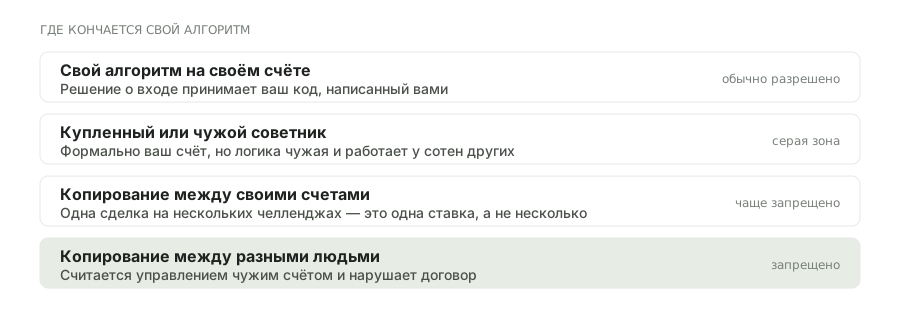
Copying is not only a configured copier. The rules look at the result: if the decisions on several accounts coincide, they count as one decision, whoever made it. Hence four gradations, of which the last two are usually prohibited.
A separate case is one traders do not consider copying at all: one strategy run by hand on two of their own challenges. Formally there is no copier; in fact these are the same trades at the same time. Some firms treat it as a breach and some do not, and the distinction lies in the wording about linked accounts rather than in the section on advisors.
Multiple accounts: when several accounts are legitimate
Holding several challenges at one firm is usually allowed — the practice of averaging the probability is built on it. It becomes a breach in three cases, and all three are about the link between accounts rather than their number.
Accounts are deemed linked by name, device, network address and payment details. Registering in a relative's name does not get round the check: the payout details must match the account holder, and that comes to light at verification.
Frequently asked questions
Are advisors allowed in prop trading?
It depends on the firm: you will find full permission, a requirement that the code be yours, a regime with mandatory clearance and a complete ban. There is no general rule, and the wording sits in the section on prohibited practices.
Why are purchased advisors banned while your own are allowed?
Because of scale, not because of automation. A commercial algorithm runs at hundreds of clients at once, and the firm gets one bet multiplied across hundreds of accounts instead of a set of independent evaluations.
What counts as copying trades on a prop account?
Decisions coinciding across several accounts, whatever the method. A configured copier, repeating trades by hand and the same advisor on two accounts differ in technique but not in result.
Can I hold several challenges at one firm?
Usually yes, and it is common practice. What makes it a breach is not the number of accounts but the link between the decisions: identical trades, opposing positions or someone else's access.
What are multiple accounts at a prop firm and why are they dangerous?
The term covers several accounts held by one person, including ones registered in other people's names. They are dangerous because on discovery every account is closed at once, including a funded one with profit earned, and the fees are not returned.
How does a firm identify linked accounts?
By name and documents, device and browser fingerprint, network address, payment details, and by coinciding times and parameters of trades. The last sign works even under different names.
Can a second account be registered in a relative's name?
Formally that is already a way round the rule, and in practice it does not work: the payout details must match the account holder, and the discrepancy surfaces at verification, when the profit already exists.
Does a trailing stop from a third-party utility count as a breach?
Under a complete ban on automation, yes, formally it does. That is the case where written permission is worth getting in advance: the utility itself is harmless, but the rule does not distinguish.
Do I have to prove that the advisor was written by me?
If the rule requires your own code, yes, and usually at payout rather than at purchase. A practical tip: keep the development history, not just the finished file.
Can I trade one strategy but with different parameters?
That is closer to independent decisions and usually passes. But if the trades still coincide in time and direction, a difference in parameters will not convince the firm — it looks at the result, not at the settings.
Read next
