 PPTF
PPTFProp broker commission, spread and swap
Prop broker commission, spread and swap are deducted before profit is counted — and therefore before the split is applied. We work through the three amounts that make up the price of a single trade, and why the spread on a prop account can differ from a broker's.
Three deductions in a single trade
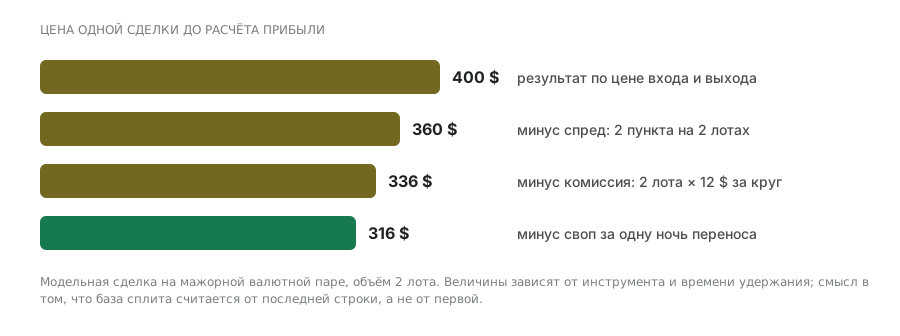
The result between entry and exit price is not yet profit. Before the split is applied, three amounts are deducted from it, and each is counted in its own way: the spread from size and instrument, the commission from the number of lots, the swap from the holding time.
| Deduction | What it depends on | In an example on 2 lots |
|---|---|---|
| Spread | Instrument, time of day, liquidity provider | $40 |
| Round-turn commission | Number of lots, the programme's rate | $24 |
| Swap | Number of nights held, the instrument's rate | $20 |
| Total | It adds up | $84 |
On a single trade $84 looks trivial next to a $400 result. But what you should count is not the trade but the period: at 200 lots of turnover per cycle the same amounts come to about $800 — and that is deducted from the base your share is then taken from.
Why a prop account's spread differs from a broker's
On a prop account it is the firm's engine, not only a broker, that stands between your button and the price. Two effects follow that do not exist on an ordinary account.
What makes the spread different
- The firm's mark-up
- Where execution is internal, part of the spread stays with the firm. It is one of its four revenue sources, and it grows with your turnover.
- Its own liquidity provider
- Prices come not from your broker but from the provider the firm has chosen. The spread on one and the same instrument can differ noticeably.
- The execution model
- On a simulated account slippage is set by the engine's rules. It can be softer than the market's or harsher — but it is different.
You can check this before buying: spreads are published in the instrument specification and the execution model in the account description. If there is no specification, that is the same red flag as the absence of rules.
What costs do to your strategy
Costs do not simply reduce the result — they hit different strategies differently, and that changes which firm to choose.
Frequently asked questions
What commission does a prop broker charge?
The rate depends on the programme and the instrument and is stated in the specification: usually per round turn per lot. The order of magnitude on major currency pairs is a few dollars per lot, but there are also programmes with no commission and a wider spread.
Why is a prop account's spread wider than a broker's?
Because quotes come from the provider the firm has chosen, and with internal execution part of the spread stays with it. That is one of its revenue sources, and it grows with your turnover.
Does swap accrue on a prop account?
Usually yes, by the same rules as at a broker: for holding a position overnight. There are programmes without swap, but there its role is normally taken by a wider spread or a commission.
Do costs count towards the drawdown limit?
At some firms they do. For a high-turnover strategy that is not a rounding error: two hundred lots at $4 is $800, comparable to a stop. Look for the wording next to the description of how the limit is calculated.
What is swap-free and when do you need it?
An account without swap: no interest is credited or charged for holding a position overnight. Instead of swap some firms charge a fixed fee for holding, and for a position strategy that changes the arithmetic of costs: swap depends on rates and on the direction of the position, a fixed fee does not. What your firm charges is written in the account specification.
Are costs deducted before the split or after?
Before. The split applies to profit after trading costs, so turnover reduces your share twice: first it lowers the base, then the percentage is taken from the lower base.
How do I find out my costs in advance?
From the instrument specification: it states the typical spread and the commission. Swap is published separately, usually as a table by instrument. Multiply by your expected turnover per cycle — that is the figure for the calculation.
How can costs be reduced without changing the trading itself?
Sometimes: move to an instrument with a tighter spread, trade in the liquid hours, do not hold positions overnight. But if the strategy lives on turnover, costs are a built-in property of it.
Which is dearer, commission or spread?
It depends on the programme: some charge commission with a tight spread, some do without commission and a wide one. What you should compare is the total round-turn price at your size, not one of the components.
Do costs affect the consistency rule?
Indirectly: the rule counts the share of the best day in the profit, and the profit is already net of costs. With high turnover the base is smaller, and the same amount on one day gives a larger share.
Read next
