 PPTF
PPTFProp trading: reviews and red flags
Prop trading reviews are useful not as a verdict but as a source of facts about specific refusals. We work out how to read them, which six signs mean “better not to pay the fee” and why the frame “prop trading is a scam” gets in the way of seeing the real risks.
How to read reviews so that they are useful
The rating in a review says almost nothing: an unhappy trader has usually lost an account, a happy one has received a payout, and both are describing their own outcome rather than the properties of the firm. What is useful is not the rating but the detail.
A review is valuable when it names the specific grounds for refusal and the specific trade. That kind can be checked against the rules to see whether it applies to you.
verifiableA public reply citing a clause is a good sign. A reply of the “please contact support” kind to a specific accusation is a bad one.
the position is visibleEvery firm has refusals: rules do get broken. Their absence from the reviews means filtering, not flawless operation.
a sign of selection“They took my account” most often means a breached limit — the outcome the rules provide for. The only disputable situation is one where no rule was broken.
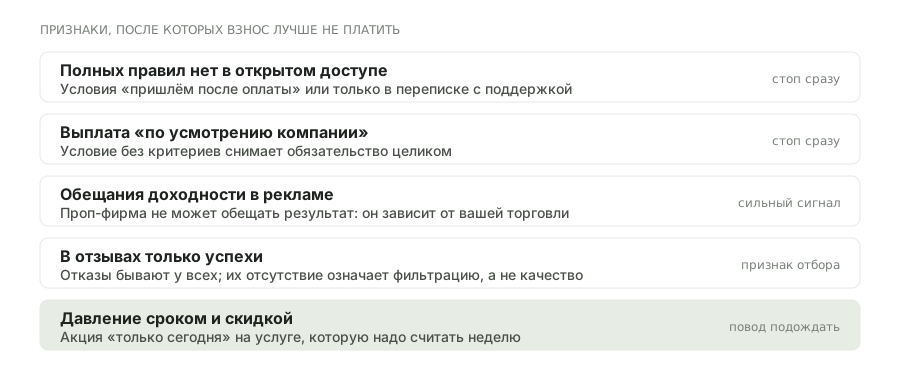
different thingsSix signs after which the fee is best left unpaid
These are not signs of fraud — they are signs that the terms cannot be verified. The first two are sufficient on their own: there is no point looking further.
Why “prop trading is a scam” is the wrong frame
An accusation of fraud usually rests on two arguments: the account is simulated and most people lose the fee. Both facts are true, but what follows from them is not “fraud” but “a service with a low probability of success and tough terms” — and those are different things with different consequences.
The My Forex Funds case is instructive here, cited by both sides as an argument and usually only by halves. We give it in full, because either half misleads in its own direction.
| What happened | When | What it means |
|---|---|---|
| The CFTC filed suit against Traders Global Group and Murtuza Kazmi, doing business as My Forex Funds | 29.08.2023 | Over 135,000 clients and no less than $310m in fees; an asset freeze and a temporary receiver |
| The court substantially narrowed the asset freeze and removed the receiver | November 2023 | The first half of the story, the one usually quoted, ends here |
| The suit was dismissed in full, the case terminated | later | The allegations were not upheld in court |
| Over $3m in costs and sanctions under Rule 11 was awarded against the CFTC | the same ruling | The court pointed to false testimony by a CFTC investigator about a transfer of CAD 31.55m, which was in fact a payment to the Canadian tax authorities |
The conclusion from the case favours neither side of the argument. It shows that both a regulator's allegations and a firm's defence need checking — and that citing a “well-known case” while knowing half of it means being wrong. The sources are in the methodology.
Frequently asked questions
Is prop trading a fraud or not?
Neither, as a category. It is a service: a paid evaluation with a low probability of passing and tough terms. What becomes fraud is not the model but a particular firm — if its terms cannot be verified or it does not honour them.
How should prop firm reviews be read?
Look in them for detail rather than a verdict: the specific grounds for refusal, the specific trade, the firm's reply citing a clause of the rules. A rating reflects the author's outcome, not the firm's properties.
Why are the reviews all complaints?
Because someone who lost an account is more motivated to write than someone who got paid. That is a sampling bias, not statistics. The reverse picture — nothing but successes — means the reviews are being filtered.
What if the firm does not answer the accusations?
Treat that as the answer. A public reply citing a clause of the rules is a good sign; silence or a brush-off in response to a specific accusation is a bad one, and it can be checked before paying.
Is a simulated account already deception?
Not if it is stated. FTMO, for instance, says so plainly about its accounts. Deception would be claiming that capital is handed to you while the execution is simulated — that is the wording worth checking.
Does the My Forex Funds case prove that props are fraudsters?
No, and it does not prove the opposite either. The CFTC's suit of August 2023 was dismissed in full, and over $3m in costs was awarded against the CFTC itself under Rule 11 — the court pointed to false testimony by its investigator. Both halves have to be cited.
Which signs mean “do not pay the fee”?
Two are sufficient on their own: the full rules are not publicly available, and the payout is “at the company's discretion”. Four more are strong signals: promises of returns, pressure from a deadline on an offer, no instrument specification and numbers that differ between the firm's own documents.
Does regulation help tell a reliable firm apart?
Barely. A prop firm usually raises no third-party funds and does not fall under licensing, so the absence of a licence says nothing in itself. Jurisdiction matters for something else — where to bring a claim.
What if the account was taken and I broke no rules?
Ask in writing for the specific clause and the specific trade. A blanket “breach of trading conditions” is not grounds. After that, a public account of the facts: that is usually the only leverage a trader has.
Is a firm with a lot of awards more trustworthy?
Awards in this industry are most often bought or handed out by the same sites that earn from affiliate referrals. What you should check is the rules, not the display case of logos.
Read next
