 PPTF
PPTFProp firm payouts: cycle and timing
Prop firm payouts do not arrive at the moment the profit is made but on a cycle — and the durations of its segments add up. We work out when the first payout from a prop account arrives, what is checked before the transfer and what to do if a prop firm has not paid.
Four segments, and they do not run in parallel
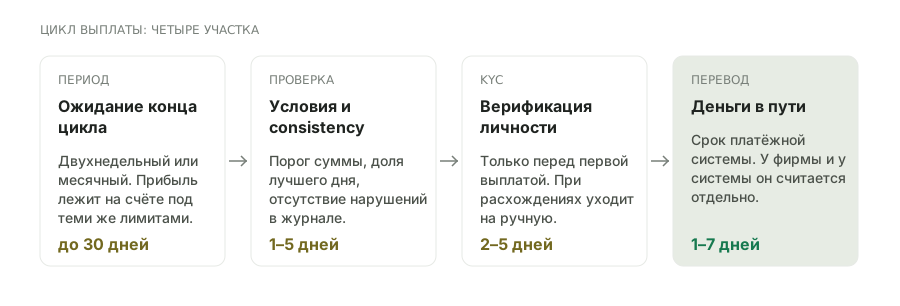
Between the profit earned and the money in your hands lie four stretches. Each firm states them separately, and they have to be added up separately too: waiting for the end of the period is not the same as the review time, and the review time does not include the payment provider's time.
| Segment | What happens | Order of duration |
|---|---|---|
| Waiting for the end of the cycle | The profit sits on the account under the same limits | up to 30 days |
| Checking the terms | The amount threshold, consistency, the record of breaches | 1–5 days |
| Verification | Only before the first payout, then never again | 2–5 days |
| Transfer | The payment provider's time, counted separately from the firm's | 1–7 days |
The main risk of the first segment. Until the profit is withdrawn it stays on the account — and obeys the same drawdown limits. A breached limit takes the account and the unrequested profit with it. That is why payout frequency is not a convenience but a way of shrinking the sum at risk.
The first payout from a prop account: why it is special
The first payout differs from the rest in three ways, and all three lengthen that one specifically.
What happens only the first time
- Identity verification
- KYC is done before the first payout. After that the documents are already in the system and this segment drops out of the cycle.
- Checking the payment details
- The recipient must match the account holder. A mismatch stops the payout until it is corrected, and correcting it is not always possible.
- Manual review of the trade log
- Some firms check the trade history for breaches of the bans precisely before the first payout. This is where breaches you did not know about surface.
Hence a practical corollary: request the first payout for the smallest possible amount and as early as possible — so that all the checks are passed while only a small sum is at risk.
A prop firm has not paid: what to do
The phrase “they did not pay” covers four different situations, and the course of action differs in each. The first thing to do is work out which one it is.
Frequently asked questions
How often do prop firms pay out?
Most often on a two-week or monthly cycle; some programmes pay on request once the threshold is met. The frequency decides how long what you earned sits on the account under the drawdown limits.
When does the first payout from a prop account arrive?
Later than it seems: the review of terms, verification and the payment provider's time are added to the cycle. In total, from one to several weeks after the end of the period.
Why does the first payout take longer than the rest?
Because of identity verification and the check of payment details — both done once. On top of that, some firms manually review the trade history for breaches precisely before the first payout.
What is the smallest amount a firm will actually transfer?
There is usually a threshold. Below it a request is not accepted and the profit stays on the account. On small accounts the threshold is sometimes comparable to a stage target.
What should you do if a payout is delayed?
First add up all four segments of the cycle and make sure the deadline has passed. Then ask in writing at which step it is being held and what is required. A blanket status with no deadline is a reason to insist on specifics.
Can a payout be trimmed rather than refused?
Yes, most often under the consistency rule: if the profit was made mostly on a single day, the amount is reduced to the share allowed by the cap. Formally that is not a refusal but the rule being applied.
Is the profit lost if a limit is breached before the payout?
Yes, entirely. Unrequested profit goes with the account, because until the transfer it is an obligation of the firm rather than your money.
How do I get paid if the payment method is not in my name?
You cannot: the recipient must match the account holder. That is both a payment-provider requirement and a sign of someone else having access to the account, which is read as a breach of contract.
Is it worth accumulating profit for one large payout?
No, for two reasons. First: what accumulates sits under the limits and can be lost. Second: a large sum more often triggers a manual review, and consistency too if it was made unevenly.
Does the payment method affect the timing?
Yes, noticeably: a bank transfer is usually slower than e-wallets and crypto. The firm states the payment provider's time separately from its own processing time, and you have to add them up yourself.
Read next
