 PPTF
PPTFProp account and funded account
A prop account is neither a deposit nor your own account at a broker. We work out what a prop account is in trading, how a funded account differs from an ordinary one and why in most programmes a funded account is simulated.
A prop account is the firm's account with your access
A prop account is a trading account opened in the name of a prop firm to which you are given access under a contract. A funded account is the same thing, but the term is usually used for an account after the evaluation has been passed, when the profit target is gone and a split has appeared.
Three consequences of the account not being yours, and all three change practice:
What cannot be done with a prop account
- Withdraw funds from the account
- There is nothing to withdraw: the money you paid is not there. There is a payout — a transfer of your share of the profit from the firm's funds under a contract.
- Change broker or platform
- The execution terms are set by the firm. If the spread or the engine does not suit you, what has to change is the firm, not a setting.
- Move the trade history
- The statistics stay inside the firm's system. When you move to another firm you have to prove your results from scratch.
A real or a simulated funded account
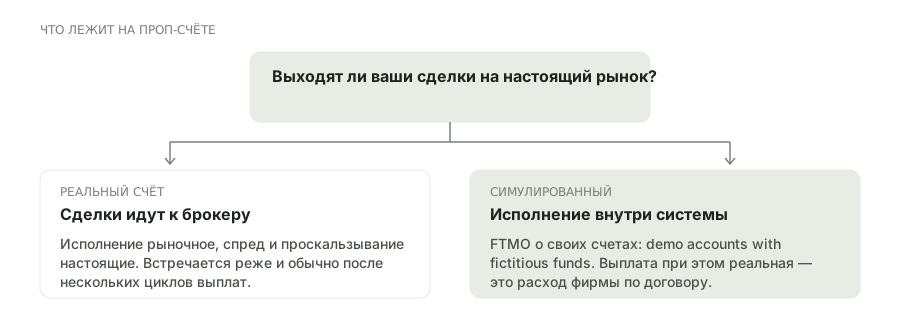
This is the main distinction, and it is almost never written in the shop window. In simulated mode trades are executed inside the firm's system; in real mode they go out to a broker. FTMO says plainly what its accounts are: all accounts we provide to our clients are demo accounts with fictitious funds, and the wording “up to $200,000 simulated capital” describes simulated capital.
That is not deception: the payout is real in both cases and the mechanics work. But for the trader the distinction is practical — it changes the quality of the statistics you get.
| A simulated account | A real account | |
|---|---|---|
| Where the order goes | Into the firm's internal engine | To a broker, into the market |
| Slippage | Modelled by the engine's rules | Market |
| Gaps and jumps | May be smoothed | As in the market |
| What that means for you | The statistics do not carry over to a real account directly | The statistics are comparable with market ones |
| Is the payout real | Yes, from the firm's funds | Yes, from the firm's funds |
A prop account in trading against a brokerage one
Comparing on a single parameter is pointless: the accounts are different in nature. It is more useful to compare by what each of them limits.
Frequently asked questions
What is a prop account in plain words?
A trading account opened in the name of a prop firm, to which you are given access under a contract. You trade, the firm works out the result by its own rules and pays your share of the profit from its own funds.
How does a funded account differ from a prop account?
In practice not at all: they are the same thing, but the term funded account is more often used for an account after the evaluation. It has no profit target, but a split, a payout threshold and a cycle appear.
Is the money on a prop account real?
In most online programmes no, the account is simulated. FTMO says so plainly. The payout is real all the same: it comes from the firm's funds under a contract rather than from the trading account.
Can a prop account be topped up?
No, and that is the essence of the model: you pay for an evaluation rather than paying in a deposit. The account size can be increased only by a paid upgrade or through a scaling plan on results.
What happens to a prop account when a limit is breached?
It is closed, access ends and the fee is not returned. Unrequested profit on a funded account is lost along with the account — which is exactly why it should not be allowed to pile up.
How do I tell whether my funded account is real?
By the rules and the execution type: the words simulated, demo, virtual in the account description mean simulation. An indirect sign is the absence of real gaps and identical execution at any hour of the day.
Do statistics carry over from a prop account to a real one?
Not directly. On a simulated account slippage and gaps are modelled, so the curve can turn out smoother than the market's. The difference is worth testing on a small real size rather than taking on trust.
How many prop accounts can you have at once?
Usually several, and it is common practice. The restriction is not on the number of accounts but on the link between the decisions: identical trades on several accounts and hedging between them are prohibited at most firms.
Who owns the profit on a prop account before a payout?
The firm. Your share becomes yours at the moment of payout; before that it remains an obligation of the firm. Legally it is closer to a receivable than to money held in custody.
Can a prop account be traded by hand and by an advisor at the same time?
Technically yes, if advisors are allowed. But the firm looks at the result rather than the method: trades that coincide with other people's in time and direction can be read as copying.
Read next
