 PPTF
PPTFHow much can be earned in prop trading
How much can be earned in prop trading is a question with no honest average answer. We work out what data exists at all, why prop trading income cannot be forecast and how to work out an upper bound for your own case.
Why there is no average answer
An average income in prop trading cannot be worked out, for three reasons, and none of them is removed by searching harder for data.
Firms do not publish the share of those who pass or the share of those who get paid. All there is are estimates by commercial aggregators, who have an interest of their own.
there is no sourceEven if an average were known, it would say nothing about the typical case: a few large results pull it up.
an average is no useThe win rate, the average R and the size are yours. Someone else's average describes a sample in which most had no edge at all.
the figure is personalWhat we will not do. Give a figure of “so much a month”. Any such number is either advertising or an average over a sample you are not part of. Instead, below is what is known, with the source named, and a calculation you can repeat.
Prop trading income: what is known from aggregators' estimates
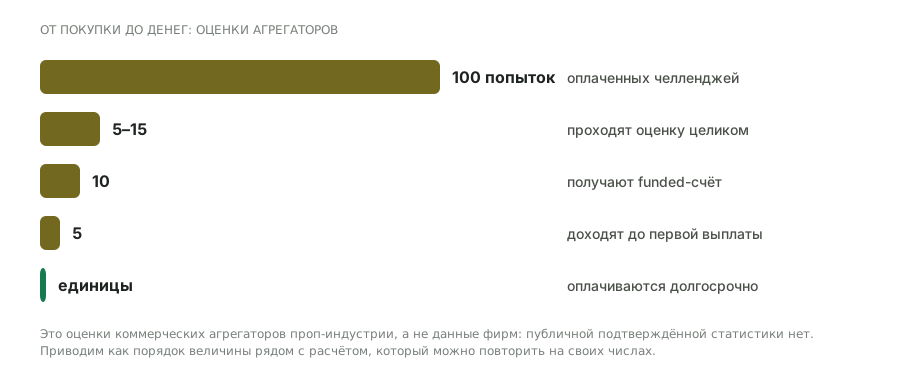
Commercial prop-industry sites publish estimates. These are not firms' data and not independent research: aggregators earn from affiliate referrals, so the numbers should be held as an order of magnitude.
| Stage | Aggregators' estimate | What it means |
|---|---|---|
| Pass the evaluation in full | 5–10 % | Roughly one attempt in ten gets through |
| Reach a funded account | around 10% | Some of those who pass never activate the account |
| Receive at least one payout | about half of those who get there | That is around 5% of everyone who bought |
| Paid over the long term | a few per cent | That is a few per cent of those who got there, not of those who bought |
Put together in one picture: out of a hundred paid attempts about five reach a first payout, and a handful reach a durable income. That is not a verdict on the model, but it is the scale on which a budget should be planned.
How to work out an upper bound for yourself
Instead of a market average you work out your own chain: the probability of passing on your own statistics, the spend on attempts, the payout per cycle and the number of cycles. The result will be an upper bound, because every assumption in the model pushes it up.
Three numbers in this calculation are ones you set yourself, and everything depends on them. The probability comes from the pass calculation, the payout per cycle from the after-split calculation, and the number of cycles has no honest estimate: the limits on a funded account are the same as on the stages.
Frequently asked questions
How much can be earned in prop trading?
There is no honest average answer: firms publish no statistics and the distribution is extremely uneven. What you should work out is your own chain — the probability of passing, the spend on attempts, the payout per cycle — and hold the result as an upper bound.
What prop trading income counts as realistic?
The question is put wrongly: income is not a property of prop trading but a consequence of your statistics and your size. With no edge the realistic income is negative whatever the firm.
How many people get paid at all?
By commercial aggregators' estimates, about half of those who reach a funded account — that is, roughly 5% of everyone who bought a challenge. These are not firms' data: no confirmed public statistics exist.
Why can't I simply take the market average?
Because it describes a sample that includes both people with no edge at all and people who took twice the size they could afford. Your probability depends on your numbers, not on their average.
Can you live on income from prop trading?
A few per cent of those who reach a funded account get paid over the long term — by the same aggregators' estimates. Planning a steady income on that basis means betting on landing in that percentage.
Why do so few reach a first payout?
Four filters compound: two drawdown limits, the requirement on the timeline and the consistency rule at payout. Each cuts off a part, and the product comes out small.
Does account size affect income?
Proportionally: the limits are set as percentages, so the probability does not depend on the size while the sums grow with it. The spend on attempts grows with the sums too.
Which gives more, one large account or several small ones?
The expected result is the same, but several accounts reduce the spread: failing one does not wipe out everything. In exchange the total spend on fees grows.
Can income from prop trading be called passive?
No. It requires trading to a schedule: minimum trading days, the spread of profit across days, the payout cycle. It is work under a strict regime, not passive income.
Which matters more for the total, the split or the probability of passing?
The probability, by an order of magnitude. The difference between an 80% and a 90% split is a few per cent of the total; the difference between a probability of 10% and 30% changes the number of paid attempts threefold.
Read next
