 PPTF
PPTFBreaking prop rules and losing the account
Breaking a prop firm's rules and blowing a prop account are two different outcomes with different consequences. We work out why a challenge is most often blown, how closure on a limit differs from closure on a ban and why the second comes to light latest of all.
Two different outcomes: blowing up and breaching
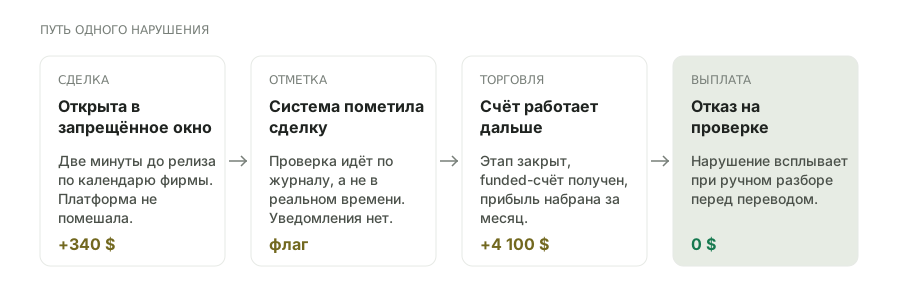
Blowing a prop account means breaching the drawdown limit. It is an outcome the rules provide for: the account closes automatically, the cause is visible in the statistics, and there is nothing to argue about. A breach means failing to observe a ban. The account may go on working, and the consequence comes later, sometimes at payout.
The difference matters in practice. After blowing up it is clear what to do: recompute the size and buy a reset, if there is one. After a breach nothing is clear: there is usually no notification, trading continues, and what is lost is not only the fee and the time but all the profit earned.
| Blowing up on a limit | Breaching a ban | |
|---|---|---|
| When it happens | At the moment of the breach, automatically | At a review of the log — sometimes months later |
| Notification | Yes, the account is closed at once | Often not: trading continues |
| What is lost | The fee and the time | The fee, the time and all unrequested profit |
| Is a reset possible | Usually yes | Often not: a reset after a breach is prohibited |
| Is there anything to dispute | No, the fact is in the statistics | Yes, and the firm interprets it |
Why challenges are blown: three causes by frequency
The causes of failure are unevenly distributed, and the first covers more than half the cases in the model calculation. None of the three is about entry precision.
The lot is worked out from the profit you want. The daily limit is then breached by an ordinary run of stops, and the outcome is settled before the first trade.
more than half“Maximum loss 10%” with no base is half a rule. Trailing from equity closes an account where a static limit from balance would have left a cushion.
second most commonIncreasing size after losses cuts the number of stops to the limit precisely when the streak may still continue.
thirdWhat to do after the account is closed
What to do depends on which outcome it was, and the first step is to establish exactly that. The cause is visible in the account statistics: a breached limit is stated outright, a breach as a wording from the rules.
Frequently asked questions
What counts as breaking a prop firm's rules?
Failing to observe any ban in the rules: trading in a news window, holding over the weekend where that is prohibited, hedging between linked accounts, prohibited classes of strategy, someone else's access to the account, a mismatch of data at verification.
How does blowing a prop account differ from a breach?
Blowing up is a breached drawdown limit, an outcome the rules provide for: the account closes at once and there is nothing to dispute. A breach is failing to observe a ban: the account may go on working, and the consequence comes at a review, sometimes at payout.
Why are challenges most often blown?
Because of size chosen for the target rather than the limit. At that size the daily limit is breached by an ordinary run of stops, and the outcome is settled before the first trade. Entry precision changes nothing there.
Does the firm notify you of a breach?
Usually not. The check is done from the log rather than in real time, so a breach can surface months later — most often at a manual review before a payout.
Can an account be restored after a breach?
As a rule no: a reset after a breach is prohibited at most programmes, unlike a reset after a failure. The condition sits next to the description of the reset, and it is worth reading before buying.
Is the fee returned when an account is closed?
No. The fee pays for an attempt and is returned neither after blowing up nor after a breach. A refund, where promised, is tied to the first payout rather than to the outcome of an attempt.
What if I think the closure was unfair?
Ask in writing for the specific clause of the rules and the specific trade that served as grounds. A general “breach of trading conditions” is not grounds, and insisting on specifics is reasonable.
Is profit on a funded account lost in a breach?
Yes, unrequested profit goes with the account. That is exactly why payout frequency is not a formality: what you earned sits under the same rules until it is transferred.
Does one breach affect my other accounts?
If the accounts are deemed linked, yes, and that is the harshest scenario: the whole set is closed. The link is established by name, device, payment details and matching trade parameters.
Can a breach be prevented technically?
Partly: the firm's event calendar in the terminal, automatic closing before the weekend, a separate network address. But broad wordings cannot be closed technically — they are closed by agreeing them in writing before trading starts.
Read next
