 PPTF
PPTFDay plan to the target
A day plan to the target shows in how many days a stage closes by the rules rather than by your wishes. Minimum trading days and the consistency rule set the timeline more firmly than the speed of making profit does.
Calculation
Of these, consistency sets — —. A cap of 0% means the programme has no consistency rule. With a cap of 50% the profit cannot be made in fewer than two days, and with 25% in fewer than four, whatever the requirement for minimum trading days says.
The consistency rule sets the timeline more firmly than minimum days do
The requirement of “a minimum of four trading days” looks like the main constraint on the timeline. In fact the consistency rule almost always overrides it: if one day must not give more than half the whole stage profit, then at least two days are needed — and with a cap of 25% at least four, with 20% five.
| Cap on one day | Minimum days | Plan per day from a 10% target |
|---|---|---|
| 50 % | 2 | 5.00 % |
| 33 % | 3 | 3.33 % |
| 25 % | 4 | 2.50 % |
| 20 % | 5 | 2.00 % |
| 10 % | 10 | 1.00 % |
Hence the practical conclusion: the consistency rule is not a formality at payout but a constraint on the whole strategy for passing. A strategy that earns through rare large trades runs into it before it runs into the drawdown limits.
One bad day wipes out several days of the plan
The asymmetry here is built into the rules. The plan per day is worked out from the target and divided across all the days of the stage, while the daily limit on losses is a single amount, and usually several times the daily plan. With a 10% target over four days the plan is 2.5% a day and the daily loss limit is 5%: one maximum losing day wipes out two days of the plan.
That is exactly why a day plan is worked out together with the limit rather than separately. If the ratio “loss limit ÷ plan per day” is above two, the stage survives one bad day only if there is slack in the timeline.
How to read the result
What the calculation does not account for
A day plan is arithmetic division, and it says nothing about three things that decide the timeline in practice.
- Profit does not arrive in even portions
- An even curve of $2,500 a day does not happen: results come in uneven runs. The calculation shows an average tempo, not a schedule.
- Losing days do not count towards the number of days
- The plan has four profitable days. If two days out of six turn out to be losing, the stage stretches out, while the minimum trading days accumulate faster than planned.
- The stage may have a deadline
- At some programmes the stage is capped by the calendar, and then the day plan has to be checked not only against the consistency rule but against the deadline.
Practical conclusion: use the calculation as a check for contradiction rather than as a schedule. If the daily quota comes out above the consistency cap or comparable to the daily loss limit, the plan is unachievable in principle — and that is visible before the first trade.
How it is calculated
Division, but with two checks: the daily quota is measured against the consistency cap and against the daily loss limit. It is those, rather than the arithmetic of division, that make a plan achievable or not.
| Value | Formula | In the example |
|---|---|---|
| Target in money | account × stage target % | $10,000 |
| Daily quota | target ÷ number of days | $2,500 |
| Quota as a percentage of the account | daily quota ÷ account | 2.50 % |
| Cap on one day | target × share allowed by the consistency rule | $5,000 |
| How many days a bad day wipes out | daily limit in money ÷ daily quota | 2.0 days |
In the example the account is $100,000, the stage target 10%, four trading days, the daily limit 5%, the consistency rule 50%. The quota of $2,500 fits inside the cap with room to spare, but one maximum losing day wipes out exactly two days of work — and that ratio matters more than the quota itself.
When the plan is unachievable in principle. If the daily quota is above the consistency cap, the target cannot be made in the chosen number of days: part of the profit simply will not count. The calculation shows this straight away — before the first trade.
Frequently asked questions
What is the consistency rule in a challenge?
A cap on the share of one day in the total profit. It is worded as “the best day no more than 50% of the profit of all winning days” or similarly. The point is to rule out passing on one lucky trade: the firm is testing repeatability.
Can a stage be closed in one day?
Where there is a consistency rule, no — arithmetically. With a 50% cap the minimum is two days, with 25% four. Plus a separate requirement for minimum trading days, if there is one. What applies is the greater of the two.
Is the plan per day a target or a limit?
A guide. Exceeding it is not prohibited until the cap on one day under consistency is breached. That is exactly why the calculation has a separate “cap on one day” line: it is the amount above which a day's profit starts doing harm.
What cap should I use if the rules say nothing about it?
Zero — then the calculation shows the timeline from minimum days alone. But it is worth checking the payouts section too: the rule often appears there. The wordings are covered in days and the consistency rule.
Do losing days count towards minimum trading days?
Usually yes: the requirement is about the number of days with trades, not the number of profitable days. But the day plan is spread across profitable days only — losing days do not move it, and the loss limit wipes them out.
What does the “a bad day wipes out” line show?
The ratio of the daily loss limit to the daily plan. A value of 2.0 means one maximum losing day throws you two days of the plan back. Above four, the plan and the limit are out of proportion and the size has to come down.
What if the consistency rule appears only at payout?
That is a common case: there is no rule on the stages, and at payout the share of one day is checked. You should plan with the cap anyway, or what you earned will be trimmed at the moment when it is too late to change anything.
Why does one bad day wipe out several days of the plan?
Because the quantities are asymmetric. The plan per day is the target divided across all the days of the stage, while the daily loss limit is a single amount, usually several times the daily plan. With a 10% target over four days the plan is 2.5% and the loss limit 5%: one day throws away two.
Is it worth stretching a stage over more days?
Stretching lowers the daily plan and makes the stage more robust to a bad day, but it lengthens the timeline and increases the number of trades — and with them the chance of running into the drawdown limit. The optimum is usually between the minimum under the rules and twice that minimum.
How is a day plan related to the allowed size?
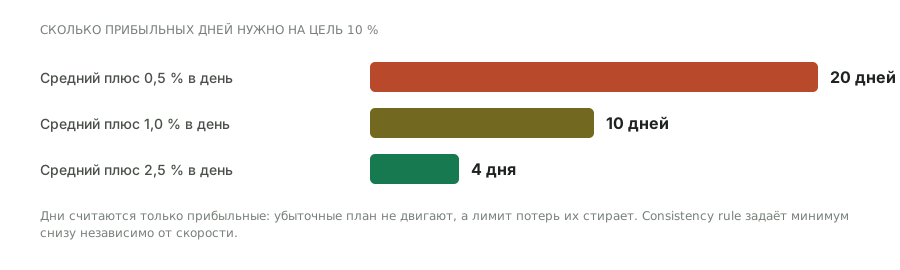
Through the daily plan in per cent. If the plan requires 2.5% a day while the allowed size at your stop yields an average of 0.5% a day, the stage will take not four days but twenty. A mismatch between the plan and the size is the most common reason a stage turns out to take twice as long as expected.
Read next
