 PPTF
PPTFProfit split
A profit split is the share of profit that stays with the trader. We work out what it is counted from, what is deducted before and after it, and why the shop-window percentage and the money on the card are different numbers.
What a profit split is
A profit split (profit split) is the rule for dividing profit between the trader and the firm. It is written as a pair: 80/20 means 80% to the trader and 20% to the firm. On the shop-window terms of the nine programmes in our list, the stated range runs from 80% to 100% in the trader's favour, most often worded as “up to 90%” or “up to 100%” on conditions.
The percentage itself is the least interesting part of the condition. What matters is three other questions, and they are what separate programmes that look alike in the shop window.
What to ask about a split besides the percentage
- What base the share is counted from
- From the trading result or from profit after trading costs? In the second case commission and spread reduce the base before the split is applied.
- Does the percentage change over time
- Some programmes raise the share after several successful cycles or under a scaling plan. The starting percentage is then not the long-term one.
- What happens on a loss
- The split divides profit but not loss: the whole minus reduces your cushion up to the limit. The asymmetry here is built into the model.
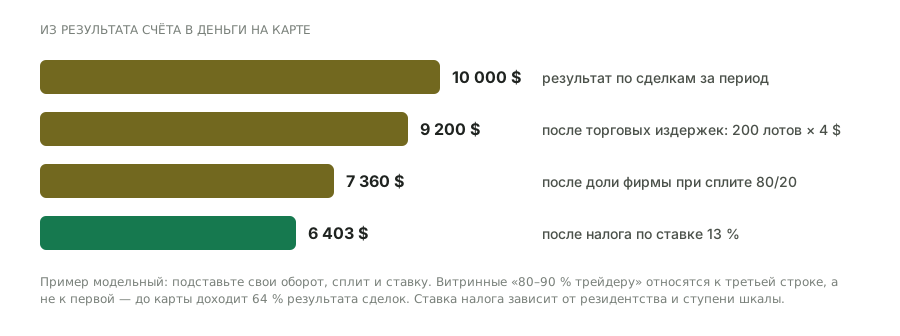
A model calculation: from the trading result to the card
Take a period in which the account earned $10,000 on closed trades. Turnover is 200 lots, costs $4 per lot. The split is 80/20. The tax rate in the example is 13%. All four values will be your own, but the order of subtraction will not change.
| Step | Calculation | Remaining |
|---|---|---|
| Trading result | the starting figure | $10,000 |
| Less trading costs | 200 lots × $4 | $9,200 |
| Less the firm's share | 9,200 × 20 % | $7,360 |
| Less tax | 7,360 × 13 % | $6,403 |
The example is a model. The tax rate depends on residency and the bracket — the details are on the page about taxes and the status of payouts. Costs depend on the instrument and the turnover, see spread, commission and swap.
Why comparing split percentages is useless
Take the same $10,000 result and the same 200 lots of turnover and see what different percentages do. The difference between 70% and 90% is $1,840 before tax. Noticeable, but smaller than the effect of the base: a programme with 90% of the trading result and one with 90% of profit after costs differ by the whole $800 of costs, though both show one and the same number in the shop window.
| The split | Your share of $9,200 | After 13% tax | Share of the trading result |
|---|---|---|---|
| 70 / 30 | $6,440 | $5,603 | 56 % |
| 80 / 20 | $7,360 | $6,403 | 64 % |
| 90 / 10 | $8,280 | $7,204 | 72 % |
The last column is what is worth comparing between programmes: the share of the original result that reached the card. It takes in the percentage, the base and the tax at once.
The split is not the only thing standing between you and the money
Even at a generous percentage a payout may not happen, or may arrive later than expected. The conditions worth reading before paying for a challenge rather than after the first profit:
Frequently asked questions
What is a profit split in plain words?
It is your share of the profit. On an 80/20 split, out of every $100 of account profit $80 is due to you and $20 to the firm. But the share is counted from profit after trading costs, and tax is then paid on your part, so less reaches the card.
What profit split counts as normal?
At the nine programmes in our list the shop window states from 80% to 100% to the trader, and almost always with the word “up to”. The number itself means little: 80% of the trading result and 95% of profit after costs can pay the same money. What you should compare is the base and the order of subtraction.
Does the split apply to losses too?
No. Only profit is divided. A loss reduces the cushion up to the drawdown limit in full, and when the limit is breached the account is closed. That asymmetry is part of the model, not an oversight.
Can my share be increased?
At some programmes the share grows under a scaling plan or after several paid cycles. The terms for that should be read in advance: they usually require both results and an absence of breaches over the period.
How often can a payout be requested?
The frequency is set by the firm: two-week and monthly cycles occur, and some programmes pay on request once the threshold is met. The cycle decides how long what you earned sits on the account under the same drawdown limits — that is, how long it can still be lost before it reaches you.
Is there a minimum payout amount?
There usually is. Below the threshold a request is not accepted and the profit goes on sitting on the account. On small accounts the threshold is sometimes comparable to a stage target, so it is worth comparing with your expected result per cycle.
How long does the money take after approval?
The firm states the transfer time separately from the cycle frequency, and they have to be added up: the cycle plus the processing time plus the payment provider's time. The real wait for a first payout is almost always longer than the shop window suggests.
Can a payout be refused if no rules were broken?
Formally no, if the grounds for refusal are listed and none of them arose. The problem arises where instead of a list there is a wording such as “at the company's discretion”: it removes the obligation entirely. That is the first thing to look for in the payout terms.
Does the consistency rule affect the size of a payout?
Yes, at some programmes. If the profit was made mostly on a single day, the payout is trimmed to the share the cap allows, or refused. The rule works not only on the stages but on a funded account too.
What happens to the account after a payout?
Usually the balance is reset to its original size, and the drawdown threshold is recomputed with it. That matters for trailing programmes: after a payout the cushion built up by profit disappears and the room to the threshold is minimal again.
Read next
