 PPTF
PPTFHow much a challenge costs
How much a challenge costs is stated honestly in the shop window — but that is the price of one attempt, not of access to an account. We work through the full cost: resets, upgrades, the terms for refunding the challenge fee and why a refund is almost never unconditional.
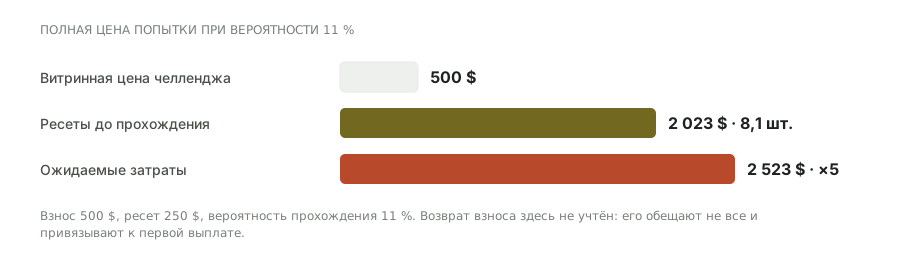
The price of an attempt and the cost of passing
The fee depends on the account size and the number of stages: the larger the account, the dearer the attempt. But a trader is paying not for an attempt but for passing — and at a realistic probability several attempts are needed.
| Value | How it is calculated | In the example |
|---|---|---|
| Shop-window price | the price of one attempt | $500 |
| Expected number of attempts | 1 ÷ probability of passing | 10.0 |
| Resets before passing | (attempts − 1) × price of a reset | $2,250 |
| Full cost of passing | fee + resets | $2,750 |
The fivefold difference between the shop window and the expected spend is not a catch and not a mark-up. It follows from the probability: at a 10% pass rate roughly one in ten paid attempts gets through. That is the sum to work out, because that is the sum you will spend.
What else is paid for separately
Four items are outside the shop-window price and appear along the way. None is compulsory, but each occurs often enough to belong in the calculation.
Usually 40–60% of the challenge price. The main addition to the cost: it is what turns $500 into $2,750 at a realistic probability.
the main additionA move to a larger account with no new evaluation. What you should work out is not the top-up but the new cost of passing: the probability does not depend on the account size.
optionalWhere the stage is capped in time, extending or removing the cap is sold separately. Useful for position strategies, useless for scalping.
situationalOn the way in when paying the fee, on the way out at payout if the firm passes it to the trader. Trivial on one attempt, noticeable on nine.
on both sidesRefunding the challenge fee: how to read the condition
A challenge refund is a promise to return the fee after the first payout. The condition is real, but almost never unconditional, and the difference between the wordings matters more than the sum itself.
A practical device: work out the payback twice — with the refund and without. If the buying decision changes with that switch, you are leaning on a condition that is not in your power.
Frequently asked questions
How much does a prop firm challenge cost?
The price depends on the account size and the number of stages. But the shop-window price is the cost of one attempt; the full cost of passing at a probability of around 10% comes out five and a half times higher because of resets.
Why do resets change the sum so much?
Because a lot of them are needed. At a probability of 10% the expected number of attempts is about nine, and eight of them are paid at the reset price. Even with a reset half the price of the challenge the sum comes out several times the shop-window one.
Is it cheaper to buy one large account or several small ones?
The probability of passing does not depend on the account size: the limits are set as percentages. So several small accounts give the same expected result but spread it over time and reduce the variance.
What is a challenge refund?
The return of the fee after the first payout. The condition is common, but the wordings differ: from a verifiable “with the first payout where it is at least X” to “at the company's discretion”, which is not an obligation.
Is the fee returned on failure?
No. The fee pays for an attempt, and on a breached limit or a breach it stays with the firm. A refund, where promised, is always tied to a successful outcome rather than an unsuccessful one.
Is the payment fee included in the challenge price?
Usually not, it is added by the payment provider. On one attempt it is trivial, on nine a noticeable sum, especially when paying through intermediaries.
Is an account size upgrade worth buying?
What you should look at is not the top-up but the new full cost of passing. An upgrade raises the expected payout and the expected spend proportionally, so the ratio between them does not change.
Are there discounts, and when?
Regularly: seasonal offers, promo codes, a refund for a review. A discount reduces the price of an attempt but not the number of attempts, so it affects the full cost of passing linearly and less than the reset price does.
Which costs more in the end, a challenge or instant funding?
It depends on your probability of passing. At a low probability instant's single payment can work out cheaper than a challenge with eight resets. The comparison is worked out in the payback calculator.
How can I tell that a price is too high?
What you should compare is not the price but the cost of passing at the same limits. A cheap challenge with trailing from equity works out dearer than an expensive one with a static limit, because the probability of passing is lower.
Read next
