Three evaluation schemes to choose from: one stage with an 8% target, two stages of 4% each and three stages of 4% each. The daily limit is trailing — counted at the end of the day from the greater of balance and equity — and the maximum is static. Advisors, news trading and copying are allowed.
How to choose a prop firm
How to choose a prop firm is a question about reading documents in a particular order, from the cheap checks to the expensive ones. Below: that order, and why lists of “the best” do not help with it.
Why there is no ranking or top list here
Searches like “best prop firm” and “top forex prop firms” assume there is an answer that suits everyone. There is not, and here is why: programme terms change without notice, and compatibility with a strategy is personal — a firm with a 3% daily limit is excellent for a scalper with a short stop and impassable for a swing trader.
There is a second, more direct reason. Public prop firm rankings are almost always built by sites that receive affiliate payment for referrals. That does not make them useless as a reference on terms, but it does make them useless as a ranking. So what you get here is an order of checking that you apply yourself, plus a disclosure in case affiliate links ever appear on our side.
What instead of a ranking. Below is a list of live programmes with their published terms: which evaluation formats exist, which limits and splits are stated, how the schemes differ from one another. The order is alphabetical, there are no scores and no “best”, and there are no links through to the firms' sites either — the terms are set out here so that they can be compared without leaving the page.
Nine live programmes: what they offer and on what terms
The order in the list is alphabetical — it is not a ranking and not a recommendation. The list is there for something else: to show how different terms can be under the single word “prop trading”, and to give a starting point for the check against the six filters above.
Programmes shown: 9 of 9. The filters are by evaluation format: most firms have several schemes, so one programme falls into several groups.
Four formats, including an account with no evaluation and direct funding. A daily limit exists only in the two-stage scheme — in the others there is a single restriction, an overall static drawdown. A stop-loss is mandatory under the rules, and holding over the weekend and through news is allowed.
Unusual mechanics: the trader chooses the drawdown limit and the stage target moves with it — from a 6% target at the minimum limit to higher values at a wide one. The split percentage is also chosen at purchase. There is a best-day rule: no more than 40% of the profit in a single session.
The most thoroughly documented programme: the terms are published as a table, which makes it convenient for working through the mechanics of the rules. In the two-stage scheme the maximum drawdown is static; in the one-stage it is trailing on end-of-day results, and a best-day rule is added there too. The firm says plainly what its accounts are: demo accounts with notional funds.
Three formats: an account with no evaluation and no profit target, one stage with a 10% target and two stages of 7% each. The type of maximum drawdown changes with the format — trailing in the fast schemes, static in the two-stage one. A higher split here is not earned by results but bought as an option.
Drawdown is measured from balance rather than equity — the floating loss of an open position does not count towards the limit until it is closed. The stage has no calendar deadline. The one-stage scheme is stricter on drawdown but requires only two trading days.
Four sets of terms for different styles: from a version with a 6% target on each stage and a tight 6% drawdown to one with a 10% target and 12% of room. In some schemes the daily limit is counted from the greater of balance and equity at the start of the day. Scaling is announced up to $2m.
A format with no evaluation stage at all: no profit target, no minimum trading days, one restriction only — drawdown. The maximum is trailing, so every new equity high pulls the threshold up behind it. The first payout opens two weeks after the first trade.
Two ranges with different logic. In the one-stage version the target is 10% against a stop-out level of 6% and a daily limit of 3%, with no minimum trading days at all. In the two-stage one the daily limit is counted from the previous day's close at 00:00 UTC+3, and the maximum drawdown from the initial balance. An account growth programme is announced separately.
How to read these cards. The numbers are taken from the firms' public terms on the verification date at the foot of the page and are given as a documented example, not as a promise made to you. Terms change without notice and differ between schemes inside one programme — which is why each card carries the format and the drawdown type rather than a full digest of the rules: check the terms in the firm's own documents on the date you apply.
And an honest word on sources. The terms of FTMO, FundedNext, FundingPips and The5ers were checked against the firms' own pages and help centres. The other five — against aggregated reviews: their sites are closed to automated checking and can only be opened by hand in a browser. That does not make the numbers invented, but it does mean that for half the list we have not seen the primary source with our own eyes; in a disputed case what the firm's rules say is what counts.
There are no links through to the firms' sites here, and that is deliberate. The page should answer the question itself — which formats exist and how they differ — rather than serve as a shop window for other people's offers; why we have no affiliate links either is set out in the disclosure.
The terms of nine programmes in one table
The same data for column-by-column comparison: click a heading to sort. The columns carry the first two lines from the card, that is, the key restrictions of each scheme.
| Programme | Evaluation format | First restriction | Second restriction | The split |
|---|---|---|---|---|
| Alpha Capital Group | 1, 2 and 3 stages | 4%, trailing EOD | 6%, static | up to 80% |
| City Traders Imperium | Evaluation or an account straight away | 10% and 5%, daily 5% | 6% static drawdown | up to 100% |
| E8 Markets | One stage, limits configurable | one stage, forex, crypto, futures | no more than 40% | 80–100 % |
| FTMO | 1 and 2 stages | target 10% and 5%, daily 5% | daily 3%, trailing EOD | up to 90% |
| Funded Trading Plus | Evaluation or an account straight away | daily 6%, trailing 6% | target 10%, daily 4% | up to 100% |
| FundedNext | 1 and 2 stages | target 10%, daily 3%, maximum 6% | 8% and 5%, daily 5%, maximum 10% | up to 95% |
| FundingPips | Several evaluation schemes | 6% and 6%, daily 3%, maximum 6% | 10% and 6%, daily 4%, maximum 12% | up to 100% |
| Instant Funding | Account without evaluation | 3% of balance | 6%, trailing | up to 90% |
| The5ers | 1 and 2 stages, with account growth | target 10%, stop-out at 6% | 10% and 5%, daily 5% | 80–100 % |
The split is the shop-window percentage a firm announces to the trader. Less reaches the card: it is counted from profit after trading costs, and tax is then paid on your share — the chain is worked through in the payout calculator.
Comparing programmes by the shop-window split is pointless: less reaches the card, because the share is counted from profit after trading costs and tax is then paid on your share.
Classic prop trading: what to compare this list with
All nine programmes above are one model: the trader pays for an evaluation, trades under the firm's rules and receives a share. But the words “prop trading” also cover a second, older thing — a company that trades its own capital and keeps a team and infrastructure to do it. The difference is fundamental: there is no fee, no challenge and no shop-window split, because the firm earns not from attempts but from the trading itself.
Cobalt Capital as an example of the desk model
By the description on its own site the company is engaged in proprietary trading and in developing software for exchanges and dealing firms: algorithmic trading systems, twelve years in algo trading, offices in Limassol and Dubai. This is exactly the case where the capital at risk is the firm's, not one paid in by a trader.
Why this is here. Before paying for an evaluation it is worth knowing that prop trading exists without a fee too — the way in is simply different: not buying an attempt but working with a team. The two models are compared in the piece on learning and working.
Open forexclassic.comThe order of checking: six filters
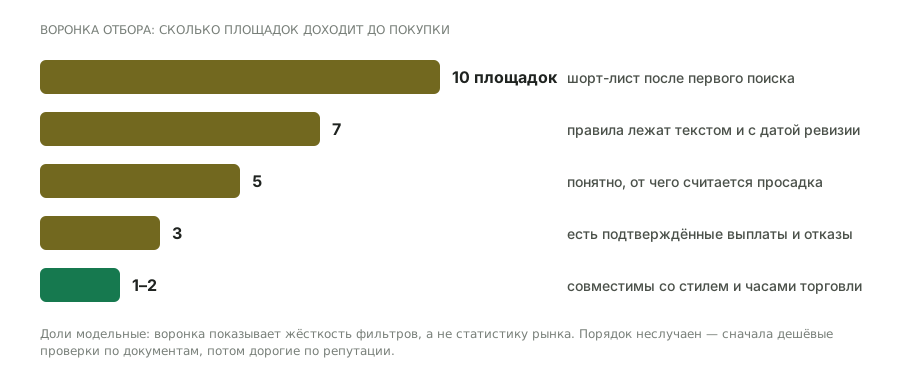
The filters are ordered from cheap to expensive: the first two take minutes and screen out the most, the last takes time and applies to whoever got that far.
The full terms are available before payment, on a separate page, with the date of the last revision. Terms available only in the support chat — stop at this step.
minutesIt says what the daily and maximum limit are measured from: balance or equity, the start or the peak. “Drawdown 5%” with no base is not a rule.
minutesThe threshold, the timing and the grounds for refusal are named. A wording such as “payout at the company's discretion” removes the obligation entirely.
half an hourThe terms name the legal entity, the country of registration and the governing law. Without that it is unclear where to bring a claim if a payout is delayed: a website and a brand are not a party to a contract.
half an hourThere is independent evidence of both. Nothing but praise is a sign that reviews are being filtered, not that there are no refusals.
hoursYour stop, time in a position and trading hours fit inside the limits and bans. Checked by calculation, not by eye.
calculationThe funnel below shows how sharply these filters cut a shortlist. The proportions are model ones: this is about the order of checking, not market statistics.
Prop trading terms: what to look at besides the price
| Parameter | Why it matters | How to check it in a minute |
|---|---|---|
| The base of the daily limit | From equity — an open loss already reduces the cushion | Find the word “equity” next to daily loss |
| The type of maximum limit | Trailing pulls the threshold up after a peak and never rolls back | Look for “trailing” and “static” in the max loss description |
| Minimum trading days | They set the minimum length of a stage whatever the result | The number of days in Trading Objectives or its equivalent |
| Consistency rule | Caps the share of one day in the profit | Look for “consistency” and “best day” |
| Bans by time and instrument | News, weekends, hedging between accounts | The prohibited practices section |
| Terms for refunding the fee | Not everyone promises a refund, and not unconditionally | Look for “refund” next to first payout |
A checklist before paying
Ten checks that cover all six filters. Your ticks are saved in the browser: you can leave and come back to the same place while checking a second firm.
Frequently asked questions
Which prop firm is the best?
The question has no general answer: limits that are comfortable for one strategy are impassable for another. Instead of picking “the best”, it is safer to run three or four firms through the six filters above and work out the allowed lot under each one's limits.
Can prop firm rankings be trusted?
As a reference on terms — yes, they are useful. As a ranking — no: most such lists are monetised through affiliate referrals, so the order in them reflects agreements rather than quality. Terms taken from a ranking still have to be rechecked in the firm's own rules.
Will there be a list of prop firms on this site?
A list yes, a ranking no. We give live firms with their published terms: limits, split, markets, the price of an attempt, the date checked and a reference to the rules. With no scores and no order “from best to worst”: such an order would reflect our arrangements rather than your problem.
Which terms should you look at first?
The drawdown base and the type of maximum limit. They decide what size you can trade — and therefore both the probability of passing and how many attempts it will take. The price of the challenge is secondary to that.
What if a firm's rules contradict each other?
Treat that as the answer to the question about choosing. A contradiction in published rules means the decisive thing will be interpretation, and the side that interprets them is the one paying the payout.
How can you check that a firm actually pays?
Look for evidence of both kinds: confirmed payouts and analyses of refusals. A firm whose reviews are all positive is more likely filtering reviews than free of refusals. Threads where the firm answers publicly and cites a specific clause of the rules, rather than “a compliance decision”, are especially useful.
Do regulation and jurisdiction matter?
Less than is usually assumed. A prop firm raises no investor money and often does not fall under licensing as a financial institution. Jurisdiction matters for something else: it decides where and how you would bring a claim if a payout were not made.
Does the My Forex Funds case prove that props are a scam?
Neither, and it has to be told in full. In August 2023 the CFTC filed suit against Traders Global Group, doing business as My Forex Funds: over 135,000 clients and no less than $310m in fees. The suit was then dismissed in full, the case terminated, and over $3m in costs were awarded against the CFTC under Rule 11 — the court pointed to false testimony by its investigator. Either half of that story on its own is misleading.
How many firms is it worth comparing?
Three or four is enough. The first two filters — rules in writing and an unambiguous drawdown base — cut most of a shortlist in minutes, and after that it comes down to the limits' compatibility with your style, which is checked by calculation rather than by comparing shop windows.
Which matters more, the price of the challenge or the terms?
The terms. The price of an attempt affects the total linearly, while the drawdown base works through the allowed size — that is, through the probability of passing and the number of attempts. A cheap challenge with trailing from equity works out dearer than an expensive one with a static limit.