 PPTF
PPTFAbout the project and authors
About the project in brief: PPTF examines forex prop trading by documents and arithmetic. Here is why it was made, how the material is prepared, who stands behind it and by what rules we handle numbers.
Why this site exists
There are two easy kinds of text to find about prop trading: advertising for firms and accusations of fraud. Neither helps much with a decision, because neither answers the questions that decide the outcome: what drawdown is measured from, what size survives a run of stops, how much is left after the split and costs.
We answer them by calculation. Rules come from firms' documents and are given as documented examples rather than as an industry standard. Market estimates are given with their author named. Every numerical claim comes with a formula the reader can repeat with their own numbers — that is what the site's nine calculators are for, and they compute in the browser, sending nothing anywhere.
How material gets onto the site
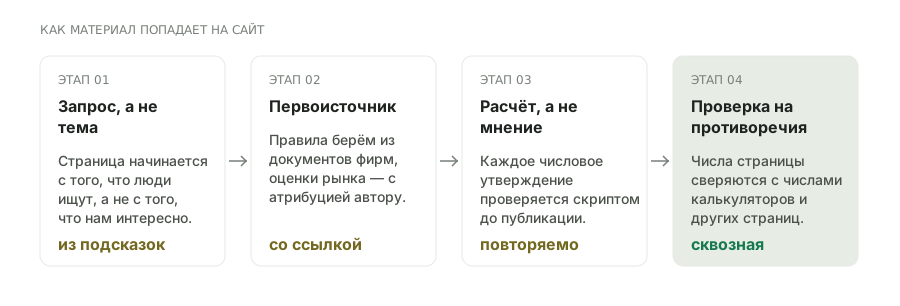
The order is the same for every page, and it explains why there are not many of them and why each carries a calculation.
Not with a topic that interests us but with what people actually search for. The core is assembled from live search suggestions; which part of the queries is confirmed and which was formulated by judgement is stated in the methodology.
from suggestionsThe firms' own Trading Objectives and general terms. They are given as a documented example with the date checked, because terms change.
with a referenceEvery claim is checked by script before publication: do the rows agree with the total, is there a division by zero, is a negative number shown as negative.
repeatableA page's numbers are reconciled with the numbers in the calculators and on other pages. A divergence between a diagram and a widget on the same page is read as an error — and corrected.
end to endWho writes it
The material is prepared by the PPTF editorial team. We do not call ourselves practising prop traders and we present no personal track records: the site is built on documents and arithmetic rather than on personal experience, and it should be checked against sources rather than against anyone's reputation.
What that means in practice: if a claim on the site cannot be checked through a reference or recomputed in a calculator, it should not be there. If you have found one, that is an error and it is worth showing us. How to do that is on the contacts page.
Three commitments you can verify
- Not one promise of returns
- Not a single page forecasts earnings: every number is a model example with its assumptions named, and next to each it is stated on what inputs it was obtained. It is easy to verify: any number on the site can be recomputed by you and come out the same.
- Not one number without a source or a formula
- Firms' rules come with a reference, market estimates with attribution to their author, calculations with the formula in the text alongside.
- Anything disputed is given from both sides
- The My Forex Funds case is covered in full — the CFTC suit and its dismissal with costs awarded against the CFTC itself. Half the story misleads in either direction.
Frequently asked questions
Who is behind the project?
The PPTF editorial team. We do not present ourselves as practising prop traders and we give no personal results: the content rests on firms' documents and on calculations the reader can repeat.
Why are there no authors' names?
Because verifiability matters more here than authority: every claim comes with a reference to a primary source or a formula. An author's name does not make a number right; a reference does.
Are you connected to prop firms?
No. There is a list of live programmes on the site, but it is a list of terms with references to primary sources — with no scores and no ranking. If affiliate links ever appear, that will be marked both on a separate page and at the point of insertion itself — see the disclosure.
How do you choose topics?
By the questions people actually ask. The core is assembled from live search suggestions; which part is confirmed and which was formulated by judgement is stated honestly in the methodology.
Do you give investment advice?
No. The material is informational, and the calculations show mechanics rather than a promise of a result. The decision to buy a challenge is yours, and it carries the risk of losing the fee.
Why is there no prop firm ranking on the site?
Because the order in such lists usually reflects affiliate arrangements, and compatibility with a particular strategy is personal. There is a list of live firms with their terms on the site — with no scores and no ranking, in alphabetical order.
How often is the data updated?
Firms' rules are given with the date checked, because they change without notice. The date is in the editorial signature on every page; that is what to look at when judging how current something is.
What should I do if I find an error?
Write to us naming the page, the disputed number and, if you have it, a reference to the primary source. We deal with such letters first: an error in a calculation does more harm than a missing page.
May I use your calculations myself?
The formulas and the logic — yes, they are not our property and are set out openly for exactly that. Copying whole page texts we do not permit: they were written for this site's particular structure.
Are other languages planned?
Yes, the infrastructure for it is in place: the site has a locale mechanism and a language switcher. So far the Russian version is published — the others will appear when they are complete rather than partial.
Read next
