 PPTF
PPTFProp KYC: verification before the first payout
Prop firm KYC is an identity check that almost always happens before the first payout rather than at the purchase of a challenge. We work through what prop firm verification consists of, which mismatches stop it and why it is worth finding this out in advance.
Why KYC comes before the payout rather than at purchase
KYC (know your customer) is a customer identification procedure. At prop firms it is arranged differently from brokers: a challenge can be bought with nothing but an email address, and documents are asked for at the moment a first payout appears.
The reason is utilitarian. A fee pays for a service, and identification is not required for that. A payout is a transfer of money to an individual, and here the firm acquires obligations to payment providers and to its own bank. For the trader that means an unpleasant sequence: a problem with documents surfaces after both stages have been passed and the profit earned.
What to check before buying rather than after
- Whether the name on the account matches the document
- Letter for letter, transliteration included. A one-letter discrepancy stops the payout until the account is re-registered, and not every firm allows that.
- Whether the firm works with your country
- The list of restricted jurisdictions is published separately from the trading rules, and it changes. Buying from a country on the list usually means losing the fee.
- What it will be paid to
- The payee must match the account holder. If there is no available method in your own name, it will never get as far as a payout.
Prop firm verification: four steps and what stalls at each
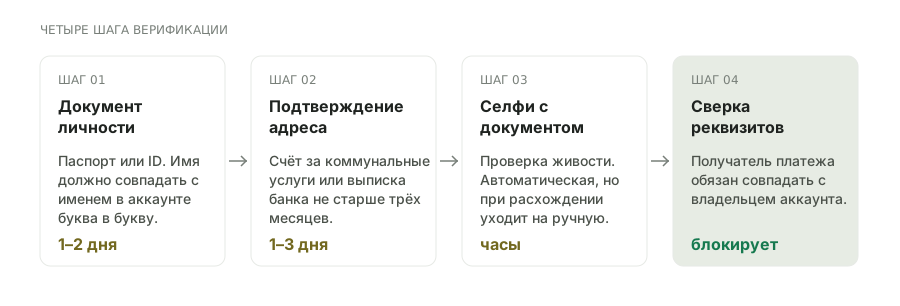
The procedure is much the same at most firms: document, address, liveness, payment details. The times add up, and in total it is days rather than minutes — worth allowing for when planning the first payout.
| Step | What is needed | A common reason for refusal |
|---|---|---|
| Identity document | A passport or ID with every field legible | The name on the account does not match the document |
| Proof of address | A utility bill or statement no more than 3 months old | The document is out of date or the address does not match |
| A selfie with the document | A liveness check, usually automated | Glare, cropped edges, the document not fully in frame |
| Checking the payment details | Payee = account holder | The wallet or account is in someone else's name |
The worst case. The account is registered in one name and the payment details are in another, even a relative's. That is both a failure of the payment check and a sign of someone else having access to the account. The second is read as a breach of contract, and then the question is no longer a delayed payout but a refused one.
How to speed it up and what to do about a mismatch
The procedure cannot be sped up, but it need not be dragged out. Almost every delay comes from three causes: the document is illegible, the address document is out of date, the name is spelled differently. All three are dealt with before, not after.
If a mismatch has already arisen, the order is: ask support for the exact wording of the problem, fix what can be fixed on your side, and get confirmation in writing. Re-registering the account under the correct name is allowed by some firms only, and usually once — so ask for it already knowing how the name is spelled on the document.
Frequently asked questions
When is KYC done in prop trading?
Usually before the first payout rather than at the purchase of the challenge. A fee pays for a service, which needs no identification; a payout is a transfer to an individual, and there the firm acquires obligations to payment providers.
Which documents does prop firm verification need?
An identity document, proof of address no more than three months old, a selfie with the document and payment details in the same name. The set is much the same everywhere; what differs is the review time.
How long does verification take?
From a few hours to a few days per step, usually two to five days in total. With mismatches it goes to manual review and the time doubles. When planning the first payout, add this to the payout cycle.
What if the name on the account is spelled differently from the document?
The payout stops until it is corrected. Re-registration is allowed by some firms only and usually once, so register from the start exactly as the document reads, transliteration included.
Can a payout go to someone else's wallet?
No. The payee must match the account holder. Trying is not only a failed check but a sign of someone else having access to the account, which is read as a breach of contract.
What if my country is on the restricted list?
Do not buy the challenge: the fee is usually not returned when verification is refused. The list is published separately from the trading rules and it changes, so check it on the date of purchase.
Is verification needed if I never reach a payout?
As a rule no — which is exactly why the problem is not discovered in advance. It is worth checking your documents before buying rather than waiting to be asked.
Is the source of funds checked?
For the fee, almost never — it pays for a service. On large payouts, though, some firms request additional documents under their bank's requirements. The condition is usually written as a right of the firm rather than a mandatory procedure.
Does a VPN affect verification?
It can: a mismatch between the document's country and the network address goes to manual review, and an address shared with other accounts adds a suspicion of linked accounts. At the payout stage a VPN is best avoided.
What if verification is stuck with no explanation?
Ask in writing which step exactly has not been passed and what precisely is required. A blanket status of “under review” with no deadline is a reason to insist on specifics, citing the published processing times.
Read next
