 PPTF
PPTFProp trading on forex, crypto and futures
Forex prop trading is the largest segment, and its rules are built differently from those on futures. We work out how a forex prop firm differs from a futures one, what happens in prop trading on cryptocurrencies and why futures prop trading is closer to the classic model.
Why forex is the main segment
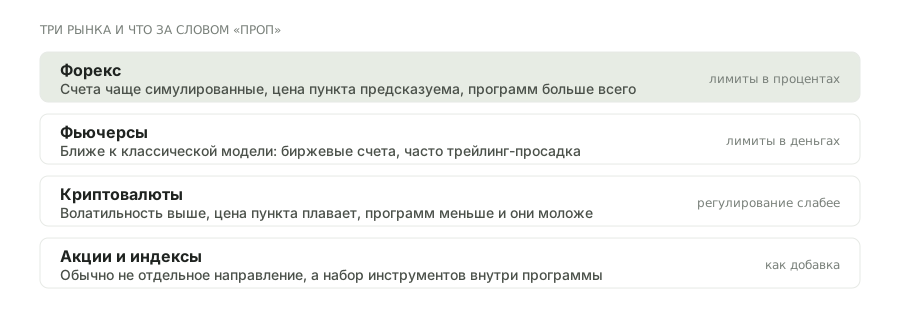
There are more programmes on forex than anywhere else, and the reason is technical: the instrument is the cheapest to simulate an account on. The pip value on a major currency pair is predictable, liquidity is round the clock, leverage is standard — the firm's engine counts the limits with no surprises.
Hence the features of the rules: drawdown limits are set as percentages, accounts are more often simulated, and the pip value in the calculations is taken as about $10 per standard lot. All the calculations on this site are built on forex arithmetic — worth remembering when you put a different instrument into them.
Three markets and what changes in the rules
| Forex | Futures | Crypto | |
|---|---|---|---|
| How the limit is set | As a percentage of the account | Often in money | As a percentage |
| Account type | More often simulated | More often a real exchange account | It varies |
| Drawdown type | Static and trailing | Trailing predominates | More often trailing |
| Pip value | Predictable | Set by the contract | Floats with the price |
| Trading hours | Round the clock except weekends | By exchange session | Round the clock |
| Number of programmes | The most | Noticeably fewer | The fewest |
Practical conclusion: a calculation cannot be carried mechanically from one market to another. On futures a limit in money at the same account size can turn out tighter than a percentage one, and on crypto a floating pip value means the allowed size has to be recomputed for every trade.
Prop trading on cryptocurrencies: what to allow for separately
The segment is younger than the others, and it shows in three places.
Equities and indices are not usually treated as a separate segment: they are a set of instruments inside a forex or futures programme. The rules there are the same; only the pip value and the trading hours differ.
Frequently asked questions
What is forex prop trading?
The largest segment of prop trading: evaluation and trading on currency pairs. Limits are set as percentages of the account size, accounts are more often simulated, and the pip value on major pairs is predictable.
How does a forex prop firm differ from a futures one?
In how the limits are set and in the account type. On forex the limits are percentages and the account is more often simulated; on futures the limits are often in money and the account is a real exchange one. The futures model is closer to classic prop.
Is there prop trading in cryptocurrencies?
There is, but the segment is younger and there are fewer programmes. The main difference is practical: the pip value is not fixed and changes with the price of the asset, so the allowed size has to be recomputed more often.
Where are the limits tighter?
What you should compare is particular programmes rather than markets. But there is a tendency: trailing drawdown is more common on futures and static on forex, and at an equal percentage static is softer.
Can several markets be traded on one account?
Usually yes, if the instruments are in the programme's specification. But the drawdown limit is shared while the pip value differs between instruments — size has to be worked out for each separately.
Do the site's calculations suit futures?
The arithmetic is the same; the inputs change: the tick value comes from the contract specification, and a limit in money is converted into a percentage of the account size. The formulas do not change.
Why is trailing more common in crypto?
Volatility is higher, and a firm considers a static threshold at the same percentage too soft: an account can run far up and come back without touching the threshold. Trailing records the peak and limits that scenario.
Are there prop programmes on equities?
As a separate segment, rarely. More often equities and indices are part of the instrument set of a forex or futures programme, with the same rules and their own pip value.
What should I choose if the strategy works on several markets?
A programme whose specification covers the instruments you need and whose limits hold for the most awkward of them. Work it out on the worst case, not the average.
Does the market affect trading hours and bans?
Yes. On futures trading runs by exchange session, and a ban on holding through the session close is more common there. On round-the-clock markets the windows around news are restricted instead.
Read next
