 PPTF
PPTFProp trading calculators
Eight prop trading calculators worth opening before you pay for a challenge, and one order in which to run them. Everything is computed in the browser: nothing is sent anywhere and nothing requires registration.
What order to calculate in
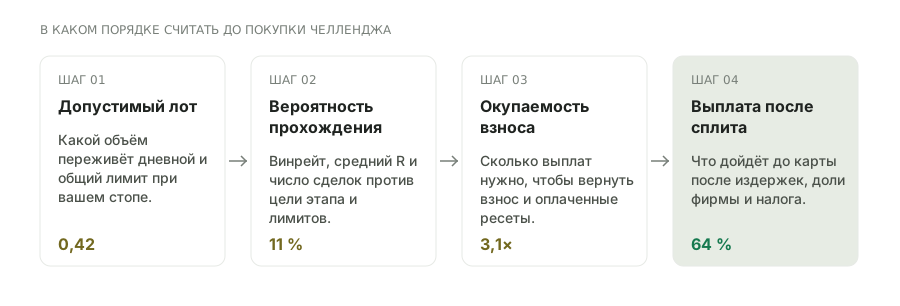
The order is not arbitrary. The allowed size sets everything else: the probability of passing, the number of attempts and whether the fee pays back all follow from it. Working out payback before size means putting a number into the formula that is not known yet.
If the first step shows that the allowed size is too small for your strategy, the rest of the calculations are unnecessary: this firm is incompatible with this style, and it is cheaper to find that out before paying.
All the calculations
The maximum size at which your stop and a losing streak do not take you past the daily and maximum limit.
02Trailing drawdown simulatorHow the threshold moves under trailing and at what moment a profitable account is one step from being closed.
03Probability of passing a challengeYour win rate, average R and number of trades against the stage target and both limits.
04Payback of the feeHow many payouts it takes to return the fee, the resets paid and the time.
05Payout after the splitWhat reaches the card out of the trading result after costs, the firm's share and tax.
06Day plan to the targetA breakdown of the stage target by day, allowing for minimum days and the consistency rule.
07Losing-streak simulatorHow many stops in a row the account survives at a chosen size — and where it breaks.
08Pass-rate scaleWhere your metrics fall into the zone from which challenges are usually passed.
Each calculator lives on one page: we will not duplicate the widget on topic pages — instead they carry a worked example in numbers with a link to here.
A worked example: how the numbers pass along the chain
One and the same input run through all four steps. You can see that the number from the previous step becomes the input for the next — which is why the order matters.
| Step | What goes in | What comes out |
|---|---|---|
| 01. Allowed lot | an account of $100,000, a daily limit of 5%, a 25-pip stop at $10, a run of 4 stops | 5.00 lots at a risk of $1,250 per trade |
| 02. Probability of passing | the same risk of 1.25%, a win rate of 45%, an average R of 1.6, a stage target of 10% | 61.8% by the model, but for budgeting we take 10% — the aggregators' estimate |
| 03. Payback of the fee | a $500 fee, a $250 reset, the 10% probability from step 02 | 10.0 attempts and $2,750 of expected spend |
| 04. Payout after the split | a $10,000 result, turnover of 200 lots, an 80/20 split, 13% tax | $6,403 on the card — 64% of the trading result |
The divergence at step 02 is not an error but the most important point in the chain. The model takes your statistics as given and reads every assumption in your favour, so its 61.8% is an upper bound. Aggregated estimates give 5–10% across everyone who bought, including those who quit. For budgeting, take the pessimistic number: an error in that direction costs time, an error the other way costs money.
What these calculations do not do
The limits of what the calculations cover
- They do not predict the result
- The probability of passing is a property of your numbers under the assumptions made, not a forecast. Change the win rate or the average R and the probability changes with it.
- They do not replace the firm's rules
- You enter the limits and the bases by hand, because every firm has its own. The default values are an example, not a recommendation.
- They neither store nor send your numbers
- The calculation runs in the browser. Not one calculator makes a network request or asks for data about you.
The assumptions of each calculation are named on its own page and collected in the methodology. If an assumption does not suit you, that is visible immediately and you can decline the result.
Frequently asked questions
Which calculator should I start with?
With the allowed lot under the drawdown. It produces the number every other calculation needs, and it most often answers straight away whether a challenge at this firm is worth buying at all.
Do I need to know my statistics in order to calculate?
For sizing — no, the firm's limits and your stop distance are enough. For the probability of passing and the day plan you need the win rate and average R from your own trades: without them there is nothing to compute.
Why are there nine calculations but eight in the list?
The ninth is this page: it sets the order in which the rest make sense. It has no widget of its own.
Is the data sent anywhere?
No. Everything is computed in the browser, the calculators make no network requests and require no registration. The only things stored locally are the ticks in the checklists and the chosen theme.
Why are the default values what they are?
They are an example, not a recommendation. The numbers are chosen so that the result is instructive: with them you can see which restriction triggers first. Your own limits and your own statistics have to be entered by hand — every firm's are different.
Can the probability of passing be trusted?
As a property of your numbers, yes; as a forecast, no. The model works out what happens at the given win rate and average R if they do not change. All its assumptions push the probability up, so the figure you get should be held as an upper bound.
Why is there no returns calculator?
Because it would require a profit forecast, and there are no forecasts here. The nearest thing in spirit is the payback of the fee: it counts not earnings but the spend on attempts and the number of payouts that returns it.
Do these calculations suit futures prop programmes?
The arithmetic is the same; what differs is the tick value and the structure of the limits: futures programmes more often use trailing and limits in money rather than per cent. Put in your own values — the formulas do not change.
What if two calculations point in opposite directions?
Look at the order. The allowed size is the starting value: if it does not suit the strategy, the other calculations are no longer about your situation. A contradiction usually means a number from someone else's scenario has been put in somewhere.
Where can I see the assumptions behind each calculation?
On the calculator's own page — the section on what it does not account for — and in the general methodology as a single list. No assumption is hidden: if one does not suit you, that is visible before you accept the result.
Read next
