 PPTF
PPTFProp firm rules: what is prohibited
Prop firms' rules contain a section on prohibited practices, and it is broken out of ignorance more often than by calculation. We work through five bans: news trading, holding a prop account over the weekend, hedging between accounts, prohibited classes of strategy and someone else's access.
Why the bans are more dangerous than the limits
A breached drawdown limit is visible at once: the account closes and the cause is clear. Breaching a ban works differently — it is recorded in the log, trading continues, and the consequence arrives at payout, when the money has already been earned. That is the worst possible sequence: the fee, the weeks and the result are all spent.
The second reason is interpretation. A limit is expressed as a number, a ban in words. A wording such as “strategies that exploit execution conditions are prohibited” covers both blatant latency arbitrage and honest tick scalping. It is interpreted by the side that pays the payout.
News trading on a prop account
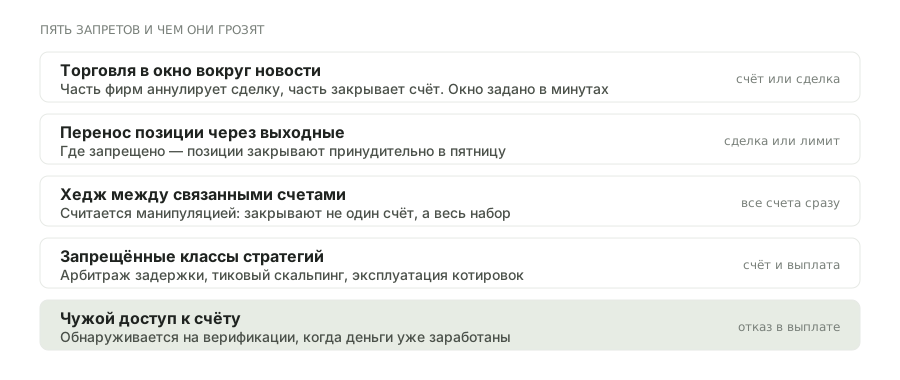
The ban is worded as a window around a release: usually two to five minutes before and after the publication of data from the firm's calendar. Three details matter, and none of them follows from general reasoning.
Three details of the news ban
- Whose calendar
- The list of events is set by the firm, and it does not match the popular calendars. An event missing from yours may be on its list.
- What exactly is prohibited
- At some firms, opening a trade in the window; at others, holding one open. The second is stricter: a position opened earlier has to be closed before the window begins.
- What the consequence is
- Voiding the trade, voiding the period's profit, or closing the account. Three different outcomes for one and the same action.
The ban more often applies only on the evaluation stages and is lifted or softened on a funded account. That too has to be checked separately.
Hedging between accounts and the other four bans
Hedging between linked accounts is the harshest in its consequences: it closes not one account but the whole set, because it counts as manipulating the model rather than a trading mistake. Accounts are deemed linked when they are in one name, from one device or from one payment method.
Where it is prohibited, positions are closed by force on Friday and the opening gap is charged to your result. Check it in the description of trading hours.
the trade or the limitOpposing positions on linked accounts. Every account is closed at once, funded ones included, and the fees are not returned.
every accountLatency arbitrage, quote exploitation, tick scalping on illiquid instruments. The wording is broad, and that is a property of it rather than an oversight.
the account and the payoutYour account being managed by another person. It is discovered at verification — that is, after the profit has been earned.
a refused payoutFrequently asked questions
What is in prop firms' rules besides drawdown limits?
Profit targets, minimum trading days, the consistency rule, windows around news, holding over the weekend, hedging between accounts, a list of prohibited strategies, verification requirements and the payout terms. The limits are only one of nine groups.
Is news trading allowed on a prop account?
At most firms, not on the evaluation stages — a window of two to five minutes before and after a release. On a funded account the ban is often lifted. The calendar of events is set by the firm and does not match public ones.
What counts as hedging between accounts?
Opposing positions in the same instrument on linked accounts, your own or someone else's. The link is established by name, device, IP and payment details. The consequence is usually harsher than for a breached limit: every account is closed.
What happens to an open position on Friday evening?
It depends on the programme: some prohibit it outright, some cap the size, some do not restrict it. Where it is prohibited, positions are closed by force and the result of that closing is charged to you.
Why are the wordings of the bans so broad?
Because it is impossible to list every way of exploiting execution conditions, so the firm reserves the right to interpret. For the trader that means: clear any disputable technique in writing before, not after.
What should I do if I broke a ban by accident?
Write to support yourself, before the payout, and get an answer in writing. Coming forward sometimes ends in one trade being voided instead of the account being closed — but there are no guarantees here.
Do the bans apply on a funded account?
Partly. News windows are often lifted; hedging and someone else's access never are. The list of bans for a funded account is usually given separately and has to be read afresh after the evaluation.
Does trading from a VPS count as a breach?
The VPS itself usually does not, but it makes the account look linked to others if the provider and the address coincide with other people's. In a dispute that works against you, so a dedicated address is preferable to a shared one.
How do I find out the window around a news release in advance?
From the firm's calendar, if it is published, or by asking support. You cannot go by popular calendars: the set of events and the minutes of the window are the firm's own.
Can one strategy be traded on several challenges?
Technically yes, but that is already close to copying between accounts: the same trade on three accounts is one bet, not three. Some firms treat it as a breach and some do not. The details are on the page about advisors and multiple accounts.
Read next
