 PPTF
PPTFMinimum trading days and the consistency rule
Two conditions set the length of a stage more firmly than the speed of making profit does. The consistency rule caps the share of one day in the result; minimum trading days are a requirement for the number of active sessions. Together they make passing on one lucky trade impossible.
The consistency rule is a cap on the share of one day
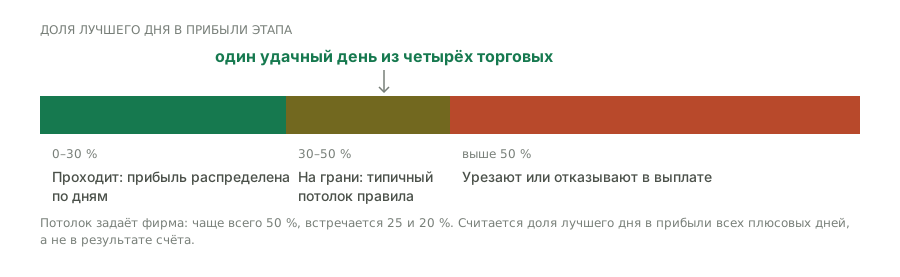
The consistency rule caps the contribution of one day to a stage's profit. The typical wording: the best day must not give more than half the profit of all winning days. There are variants about the share of a single trade and about the share of the best week, but the point is the same — the firm is testing repeatability, not a record.
An arithmetic constraint on the timeline follows, and it is rarely thought through in advance: if one day cannot give more than half, then at least two days are needed. With a cap of 25% it is at least four, at 20% five. That is a floor, and it often turns out to be tighter than the formal requirement for the number of trading days.
| How it is written in the rules | What is tested | Where it applies |
|---|---|---|
| Best day ≤ N % of total profit | The share of the best day in the sum of all winning days | More often on the stages, sometimes at payout too |
| Single trade ≤ N % of total profit | The share of one trade rather than a whole day | Hits strategies with rare large entries |
| Best week ≤ N % | The share is counted by week rather than by day | Softer for scalping, harsher for swing trading |
| Consistency check at payout | The check happens only at the moment of a payout request | There is no rule on the stages — and that lulls people |
The arithmetic consequence is the same whatever the wording: the minimum number of days is a hundred divided by the cap, rounded up. Breaking your own target down by day allowing for both conditions is in the day plan.
Minimum trading days: what counts as a day
The requirement looks simple — “a minimum of four trading days” — but it is counted in different ways. The difference decides whether a day can be closed with one small trade for the sake of the tick.
Three ways of counting a trading day
- A day with a trade opened
- The most common variant: any day with at least one trade counts, whatever the result and the size.
- A day with a trade closed
- Stricter: the trade has to be not only opened but closed within the same firm trading day. A position carried into the morning does not close the day.
- A day with a minimum size
- Less common: what is required is not the fact of a trade but a size or a movement in the result of at least a threshold. Token trades “for the counter” do not qualify.
Look for the wording in the description of trading objectives, next to the profit target, rather than in the section on drawdown.
Where time is lost. If the minimum days reset with a paid reset, the attempt takes that many days longer. At a probability of passing of around 10% and a requirement of four days, that adds more than a month to the expected timeline — an amount that is usually left out of the cost.
How the rule changes the strategy for passing
The consistency rule is incompatible with trying to take the target in one strong move. It is not a ban on a large trade — it is a requirement that as much profit again be made on other days after it. In practice the rule inverts the logic: first you choose the number of days, then the daily plan, and only then the size for that plan.
It is worth looking separately at what the plan becomes under a tight cap: at 20% you need five days, the daily plan falls to 2%, and the size requirement changes with it.
Frequently asked questions
What is the consistency rule in prop trading?
A cap on the share of one day in a stage's profit. It is most often worded as “the best day no more than 50% of the profit of all winning days”. The point is to rule out passing on a single lucky trade.
Is the consistency rule the same as minimum trading days?
No, they are different conditions, though both set the timeline. Minimum days are a requirement for the number of active sessions. Consistency is about how the profit is distributed between them. What applies is the greater of the two constraints.
Can the minimum number of days be enough?
Only if the profit is spread evenly: with a 50% cap, two days must give roughly half the result each. A deviation either way immediately breaches the cap, so you need slack in days even when the number is formally sufficient.
What counts as a trading day?
Usually a day with at least one trade. At some firms it has to be closed on the same trading day, at others a minimum size has to be reached. The wording sits in the description of trading objectives.
Does the consistency rule apply on a funded account?
At some programmes yes, and it bites harder there: profit made on a single day is trimmed at payout. Check both the section on stages and the section on payouts — the terms can differ.
What happens if the cap on one day is exceeded?
On a stage, usually nothing immediate: the stage simply does not close until it evens out. At payout, a trim to the share the cap allows, or a refusal. The account is not closed for it: this is not a breach but a non-conformity.
Do minimum days reset with a reset?
It varies by firm. If they do, the attempt takes that many days longer, and that belongs in the time budget, not only the money one.
How are the days counted, calendar or trading?
Trading days, that is, days the market is open. But the stage deadline, where there is one, is more often counted in calendar days — and thirty calendar days is about twenty trading ones.
Does the consistency rule hurt scalping?
On the contrary, scalping has an easier time of it: many small trades spread the profit across days naturally. What suffers is strategies with rare large moves.
Is there any point in trading extra days deliberately?
There is, if the rule is close to its cap: an extra winning day increases the denominator and lowers the share of the best day. But every extra trade also spends drawdown limit, so “days for the counter” are opened at minimum size.
Read next
